
Study Time Planner
Generate a balanced study schedule based on subject difficulty.
If you are a student preparing for CBSE Class 10 or 12, JEE, or NEET in 2026, you already know that a syllabus isn’t just a list of chapters; it’s a race against time. Most students fail not because they don’t study, but because they study unbalanced. They spend 4 hours on a subject they already like and only 30 minutes on the “scary” one.
Our Study Time Planner uses a “Priority-Weighted” algorithm to fix this. By categorising subjects as Easy, Medium, or Hard, it automatically distributes your available hours to ensure your weakest areas get the most attention.
How to Allocate Study Time Based on Difficulty
The biggest mistake in time management is treating all subjects equally. In 2026, the board exam patterns are shifting toward Competency-Based Questions, which require deeper focus.
The Weightage Strategy:
- Hard Subjects (Weight 3): These are topics where you consistently lose marks or feel “stuck.” They require 40-50% of your daily time. Tackle these during your Peak Productivity Hours (usually early morning).
- Medium Subjects (Weight 2): These are subjects you understand but need more practice in. They get 30% of your schedule.
- Easy Subjects (Weight 1): These are your “scoring” areas. They only need 20% of your time for quick revision and sample paper practice.
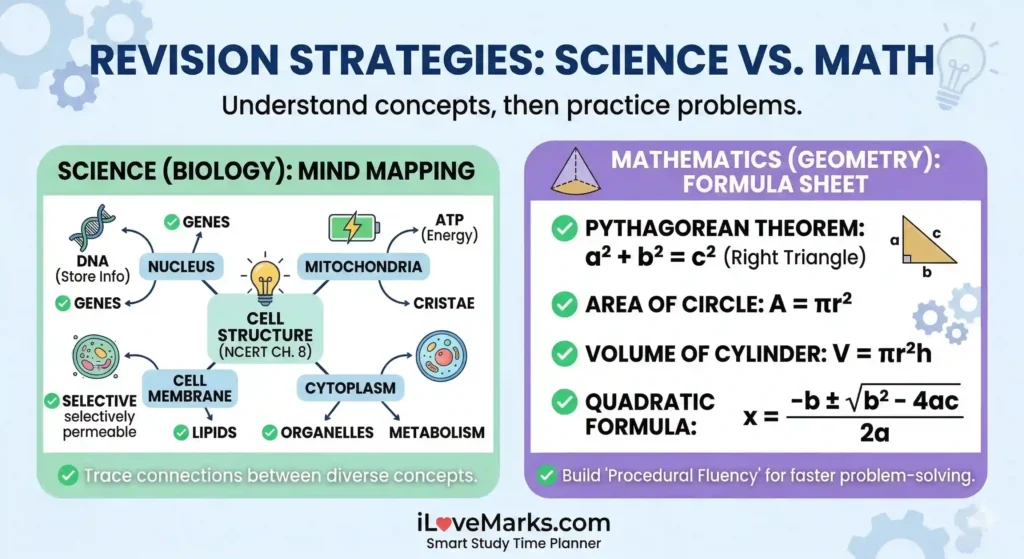
Effective Study Tips: Math vs. History
Managing different types of subjects requires different cognitive approaches.
For Mathematics & Physics (Numerical Subjects)
- The “Zero-Formula” Rule: Never just memorise a formula. Understand the derivation.
- Active Practice: Use a timer while solving numericals. Aim for 2 minutes per mark.
- NCERT Exemplar: For 2026, practising the Exemplar problems is non-negotiable for scoring 95+.
For Social Science and Biology (Theory Subjects)
- The Timeline Method: For History, create a visual timeline on your wall.
- Mind Mapping: Instead of reading full chapters, create one-page mind maps for quick revision.
- Structured Answers: Practice writing in bullet points with underlined keywords. Examiners in 2026 prefer “legible and structured” over “long and wordy.”
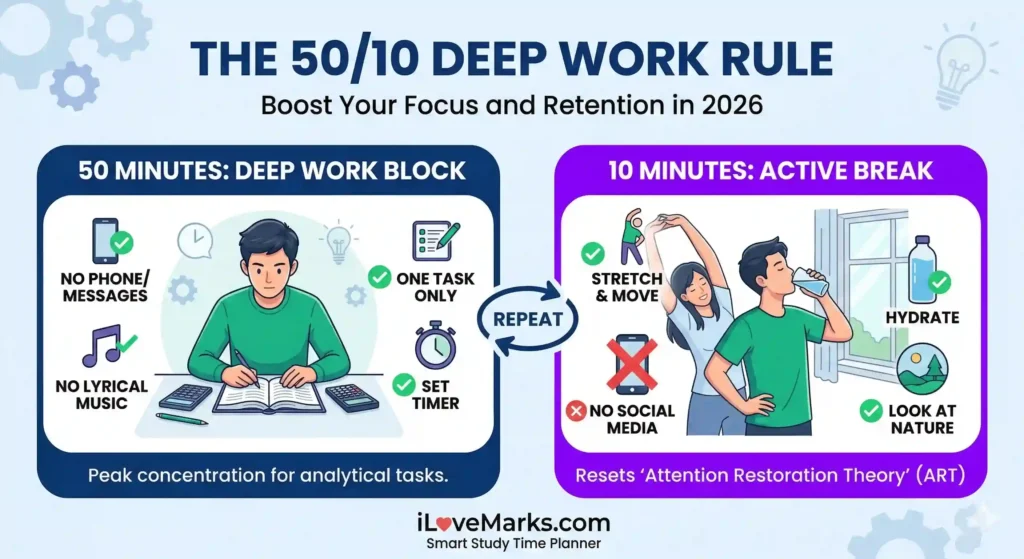
Why the 50/10 Rule is Your Secret Weapon
Studying for 5 hours straight is a myth. Science shows that after 90 minutes, your brain’s ability to retain new information drops by over 50%.
How to use the 50/10 Rule:
- 50 Minutes Focus: Pure, deep work. No phone, no music with lyrics, no snacks.
- 10 Minutes Active Break: Do not check Instagram. Instead, stretch, drink water, or do a 2-minute meditation.
Pro-Tip: During your break, try “NatureRX”, looking at a plant or stepping onto a balcony. This resets your “Attention Restoration Theory” (ART) and makes your next 50-minute block 2x more effective.
Common Mistakes to Avoid in 2026
- Ignoring Revision: If you don’t revise a topic within 24 hours, you lose 70% of what you learned.
- Multitasking: Switching between a Math problem and a Biology diagram in the same hour is a recipe for “Brain Fog.”
- Lack of Flexibility: If a chapter takes longer than planned, don’t panic. Carry it forward to the next day’s “Buffer Slot.”
Frequently Asked Questions (FAQs)
How many hours should I study daily for Board Exams?
For 2026, 4 to 6 hours of focused self-study (excluding school/coaching) is usually the “sweet spot” for toppers. Quality always beats quantity.
Is it better to study at night or in the morning?
Biology suggests that most students have a “Morning Peak” for analytical tasks (Math/Science). However, if you are a “Night Owl,” ensure you get 7-8 hours of sleep to allow your brain to consolidate memories.
How do I handle “exam burnout”?
Burnout happens when your schedule is too rigid. Build in “Leisure Slots” for hobbies or exercise. A healthy body leads to a sharp mind.
Can I use this planner for JEE/NEET?
Yes. Just input your coaching subjects. For JEE, give more weight to Mathematics (lengthy); for NEET, ensure Biology gets daily NCERT reading time.
How often should I take mock tests?
Once you complete 50% of the syllabus, take one full-length mock test every Sunday to build your “Exam Stamina.”